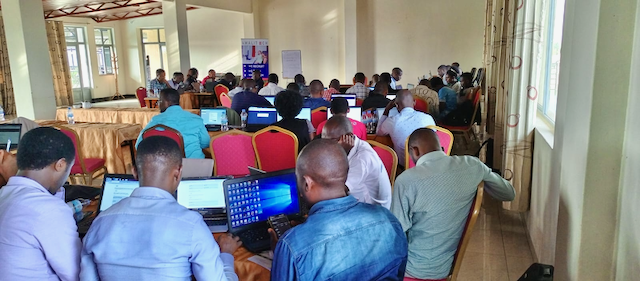
Partnering with GIZ and the Rwanda TVET Board, we examine how to encourage Rwandan TVET teachers to complete online digital skills training, and whether upskilling improves teaching practices and student learning outcomes.
Scaling Technical and Vocational Training (TVET) by leveraging digital tools has enormous potential. This is especially important in Africa, where a large youth population needs skills training at scale to support work readiness. Before deploying these tools, however, TVET teachers themselves require digital skills training. Since 2023, FOS Co-Director Raji Jayaraman has been working with the Deutsche Gesellschaft für Internationale Zusammenarbeit (GIZ) GmbH, in close collaboration with the Rwanda TVET Board (RTB), to evaluate the effectiveness of a nationwide online basic digital skills and e-pedagogy program targeting Rwanda’s roughly 8,000 TVET teachers.
The partnership has two main objectives. The first is to encourage TVET teachers to complete the training certification through a series of low-touch nudges in the form of periodic messages sent to different stakeholders, including TVET school leaders, digital skills master trainers, and teachers themselves. The second is to evaluate whether, for whom, and under what circumstances the training changes teaching practices and improves student learning outcomes. Findings from both lines of inquiry can inform the design of ongoing online training programs across educational settings in Rwanda. The work also has potential ramifications for TVET systems in other Sub-Saharan African settings, where youth unemployment remains a looming challenge.
“The collaboration with Raji and her team perfectly illustrates why research and evidence matter. With a research team open to finding solutions to the inevitable adaptations needed in real life during a project implementation, the close development cooperation between ESMT and GIZ not only enables our project to prove results and make fact-based decisions, but it also improved the implementation process from planning until final evaluation. Most importantly, the interim analysis has already provided results that really do matter for Rwanda. RTB used them to fine-tune its strategy for the further development of its digital infrastructure and trainings, and the design and apparent success of nudges can now easily be replicated within Rwanda’s Ministry of Education to expand the effectiveness of such online trainings for around 64,000 students and teachers in general education.”
– Katia Halabi, GIZ
Research Team
-
Raji Jayaraman
ESMT Berlin
-
P. Sneha
Berlin School of Economics PhD Student
Practice Partners
-
Katia Halabi
GIZ
-
Gaspard Ukwizagira
GIZ
-
Asher Mutijima
Rwanda TVET Board